
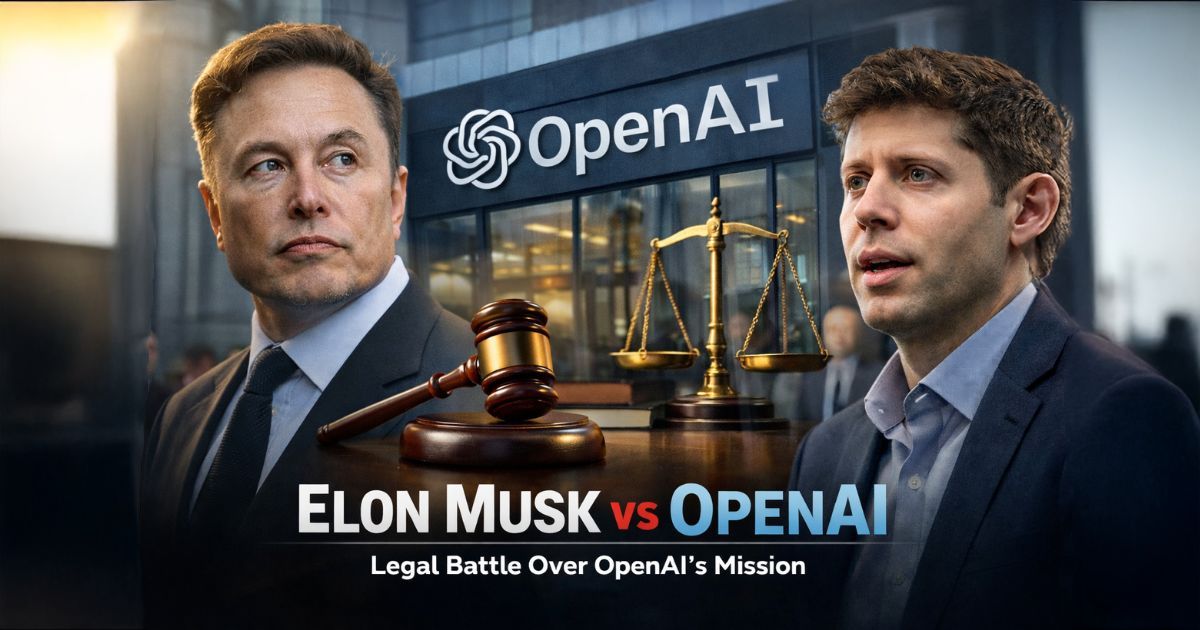
A major legal dispute involving Elon Musk and OpenAI is moving toward a jury trial in the United States. The case focuses on whether OpenAI stayed aligned with the nonprofit mission presented at its founding or later shifted course in ways that were not fully disclosed to early supporters. Recently unsealed court documents have added new detail to a conflict that has been building for years and now stands as one of Silicon Valley’s most closely watched technology lawsuits.
The documents were made public during the legal discovery process and include depositions, emails and internal records from several senior figures connected to OpenAI and its partners. A federal judge has ruled that the evidence is sufficient for the case to proceed to trial. The outcome could influence how technology companies structure mission-driven organizations and communicate with donors and investors.
Background of the dispute
OpenAI began operations in 2015 as a research group structured around a non-profit model. Its stated purpose was to develop advanced artificial intelligence in a way that would benefit humanity as a whole. The organization was co-founded by Elon Musk and Sam Altman, along with other researchers and entrepreneurs. At the time, major technology companies such as Google were investing heavily in AI research. OpenAI positioned itself as an independent counterbalance focused on public benefit rather than shareholder returns.
Elon Musk provided significant early financial support to OpenAI. Court filings state that he contributed approximately thirty-eight million dollars during the organization’s early stages. This represented a large share of its initial funding. Musk has said that his support was based on the understanding that OpenAI would remain aligned with its non-profit mission.
Over time, OpenAI adopted a structure that included a for-profit operating arm controlled by the non-profit entity. This model allowed the organization to raise substantial capital while maintaining nonprofit oversight. The structure later became a central issue in the dispute between Musk and OpenAI leadership.
Lawsuit and judicial ruling
In 2024, Musk filed a lawsuit alleging that OpenAI and its leadership departed from the commitments made to him during its founding. He claimed that the organization pursued commercial objectives that conflicted with its original mission. OpenAI denied these allegations and argued that funding models and governance structures were openly discussed.
On January 15, United States District Judge Yvonne Gonzalez Rogers ruled that the case should proceed to trial. She rejected efforts by OpenAI and Microsoft to have the lawsuit dismissed. The judge stated that the case raised factual questions that should be resolved by a jury. She also noted that credibility of testimony would play a key role in the proceedings.
The jury trial is scheduled to begin on April twenty seven in a federal court in Northern California.
Scope of the unsealed documents
More than one hundred court documents related to the case were unsealed during discovery. These records span thousands of pages and include sworn depositions, internal communications, and personal writings. Individuals whose testimony appears in the record include Sam Altman, OpenAI president Greg Brockman, OpenAI co-founder Ilya Sutskever, OpenAI executive Mira Murati, and Microsoft chief executive Satya Nadella. Former OpenAI board members Helen Toner and Tasha McCauley also appear in the records.
The documents provide insight into how OpenAI leaders discussed funding, governance and competition during the organization’s early years. Some of the material has circulated widely online following its release.
Greg Brockman diary entries
Among the most discussed pieces of evidence are excerpts from a private diary kept by Greg Brockman. Portions of the diary were cited in court filings and referenced by the judge in her ruling.
In one entry Brockman expressed uncertainty about rejecting Elon Musk’s involvement and questioned whether doing so could lead to losing Sam Altman. The entry reflects internal debate about leadership and influence at OpenAI during a formative period.
Another diary entry focused on funding and noted that financial support could potentially come from Tesla or from Google. In additional passages, Brockman wrote about the risks of publicly committing to a permanent non-profit structure if future changes were possible. He expressed concern that making such statements could later prove inaccurate. Brockman also wrote about personal financial ambitions, including a desire to become a billionaire.
Judge Gonzalez Rogers cited these writings as part of the evidence supporting Musk’s claim that he may have been misled.
Internal concerns and competition
The unsealed documents also reveal how OpenAI leadership viewed the competitive landscape. Deposition testimony shows that Satya Nadella was concerned about Microsoft’s position in artificial intelligence when discussions with OpenAI began. Microsoft later became OpenAI’s most significant commercial partner.
Other records indicate that OpenAI leaders were monitoring the growth of competing AI labs. In 2022 Ilya Sutskever and Mira Murati expressed concern about the visibility and influence of open source competitors such as Stability AI.
Internal discussions also addressed whether investors should be restricted from backing competing organizations. These conversations occurred as OpenAI sought to protect its strategic position while expanding access to capital.
Emails in the record show that Microsoft secured an early partnership with OpenAI in part because Elon Musk opposed working with Amazon founder Jeff Bezos. In a message to Sam Altman, Musk expressed a preference for Microsoft while criticizing aspects of its corporate culture.
OpenAI’s response to allegations
Following the release of the unsealed documents, Elon Musk used social media to criticize OpenAI and its leadership. He argued that the documents show awareness of plans to pursue commercial models earlier than publicly acknowledged. OpenAI responded by stating that Musk selectively quoted private writings without full context.
On January sixteen OpenAI published a blog post titled The truth Elon left out. In the post, the company argued that Musk himself supported a for-profit approach during OpenAI’s early discussions. According to OpenAI, Musk sought majority equity and full control and raised concerns based on past experiences where he lacked authority.
OpenAI stated that Musk discussed large-scale funding ambitions and succession scenarios involving his family. The company said these conversations demonstrate that financial structure and control were debated openly and not concealed.
Departure and formation of xAI
Tensions between Musk and OpenAI leadership became evident by 2017. Disagreements over strategy leadership and funding contributed to Musk’s departure from OpenAI’s board. In 2023, Musk launched his own artificial intelligence company called xAI.
OpenAI continued operating under its hybrid structure with a non-profit parent overseeing a for-profit arm. During this period, the organization raised significant funding and expanded its commercial partnerships.
The 2023 leadership crisis
The case has renewed attention on events that unfolded in November 2023. At that time OpenAI’s non profit board removed Sam Altman as chief executive. The board stated that Altman had not been consistently candid in communications.
Days later, Microsoft hired Altman to lead a new internal AI initiative. Nearly all OpenAI employees then threatened to resign unless Altman was reinstated. Within days, Altman returned as CEO, and the board was largely replaced.
These events raised questions about governance oversight and the balance of power between OpenAI and Microsoft. They also form part of the broader context examined in the lawsuit.
Transition to a public benefit corporation
In 2024, OpenAI proposed removing nonprofit oversight and converting fully into a for-profit public benefit corporation. Advocacy groups criticized the proposal, arguing that it weakened the organization’s original mission. OpenAI later revised its plan, stating that the non-profit would retain control and hold a significant ownership stake.
In October 2025, OpenAI completed its transition to a for-profit public benefit corporation. The non-profit entity remained a controlling shareholder. This structural change is not disputed in court filings.
Musk initially filed a lawsuit in California state court. He withdrew that case in June 2025 and filed a federal lawsuit in August 2025. His legal team described OpenAI’s conduct as deceptive in court filings.
Claims for damages
In the current case, Musk is seeking up to one hundred thirty-four billion dollars in damages from OpenAI and Microsoft. Court filings state that this figure represents alleged wrongful gains resulting from his early support. Musk claims that his funding and involvement helped OpenAI reach valuations estimated between sixty five and one hundred nine billion dollars.
He also alleges that Microsoft gained between thirteen and twenty-five billion dollars as a result of its partnership with OpenAI. These figures are presented as claims and have not been confirmed by a court.
Musk further argues that his contributions went beyond money. He states that he helped recruit talent, connected founders with industry contacts and lent credibility to the organization during its early years. His lead trial lawyer, Steven Molo, told Reuters that OpenAI would not exist in its current form without Musk’s involvement.
Defense by OpenAI and Microsoft
OpenAI and Microsoft dispute Musk’s damage calculations. In court filings, they have asked the judge to limit the testimony of Musk’s expert witnesses. They argue that valuation estimates are speculative, unverifiable, and unprecedented. They also contend that the lawsuit seeks an implausible transfer of value from a non-profit controlled entity to a former donor who is now a competitor.
Both companies maintain that OpenAI’s evolution was driven by the practical requirements of developing large-scale AI systems and that Musk was aware of these challenges.
What the jury will decide
The jury will be asked to determine whether OpenAI violated commitments made to Musk and whether Microsoft knowingly assisted in that breach. Jurors will also evaluate testimony regarding internal discussions, funding structures, and representations made during OpenAI’s early years.
No court has yet ruled on the merits of Musk’s claims. The trial will focus on evidence credibility and interpretation of agreements and communications.
Broader implications
The broader debate around transparency and accountability in AI systems echoes concerns discussed earlier in our analysis of how Blackbox AI is changing the way modern technology is developed and governed.
The lawsuit carries implications beyond the parties involved. It highlights tensions between mission-driven technology organizations and the financial demands of building advanced systems. The case may influence how future non-profit or hybrid technology ventures communicate with donors and investors.
Regulators, researchers and industry leaders are watching closely. A verdict in favor of Musk could encourage stricter oversight of organizations that begin with charitable goals and later pursue commercial paths.
What happens next
Pre-trial motions involving Elon Musk and OpenAI are expected to continue through March. Both sides are seeking to narrow the evidence that jurors will see. When testimony begins in April, additional details about OpenAI’s early decisions, governance debates, and its partnership with Microsoft are likely to emerge.
The trial outcome could shape public understanding of how one of the most influential AI organizations evolved and how accountability is applied when founding missions are questioned.
Conclusion
The legal dispute between Elon Musk and OpenAI has moved from internal disagreement to a public courtroom battle that will be closely examined by a jury. Newly unsealed documents have shed light on early decisions, funding discussions, and governance challenges that shaped OpenAI’s evolution. As the trial approaches, the case is expected to clarify how commitments made during the founding of major technology organizations are interpreted years later. The outcome may influence how future AI research groups balance mission-driven goals with commercial growth while maintaining transparency with early supporters.



One thought on “Elon Musk And OpenAI What Newly Unsealed Court Documents Reveal and What They Do Not”