


Every time money moves online, data is shared, or ownership changes hands, trust sits at the center of the process. Banks, servers, companies, and governments usually act as the middle layer that keeps records safe. The problem appears when that middle layer fails, manipulates data, or becomes a single point of control. Blockchain technology approaches trust from a different direction.
Instead of relying on one authority, it spreads records across a network. Every participant holds the same version of the truth. Once information enters the system, changing it quietly becomes close to impossible. This single idea has pushed blockchain from a niche concept into a core digital infrastructure used across industries.
This article explains what blockchain technology is, how it works internally, and why it has gained global attention, using clear language and real examples.
What Is Blockchain Technology?
Blockchain technology is a decentralized digital record system that stores information in a structured and verifiable manner across multiple computers.
Each record is grouped into a block. These blocks connect in sequence using cryptographic links. When combined, they form a chain that reflects a complete history of stored data.
The defining feature of blockchain lies in its shared ownership of data. No single entity controls the ledger. Every participant in the network can verify records independently.
Core Characteristics at a Glance
- Data spreads across many nodes
- Records follow a time-based order
- Cryptography protects integrity
- Past entries resist modification
This structure removes the need for blind trust.
Blockchain Explained in Simple Terms
Picture a notebook shared by thousands of people at the same time. Everyone owns a copy. When a new entry appears, all notebooks update together. Removing or changing old entries would require altering every copy at once, which becomes unrealistic at scale.
That shared notebook represents a blockchain ledger.
Each update receives approval from the network before becoming permanent. The system does not rely on reputation or authority. Verification comes from mathematics and network agreement.
How Blockchain Technology Works
Blockchain follows a fixed operational sequence. Every transaction moves through the same path before becoming part of the permanent record.
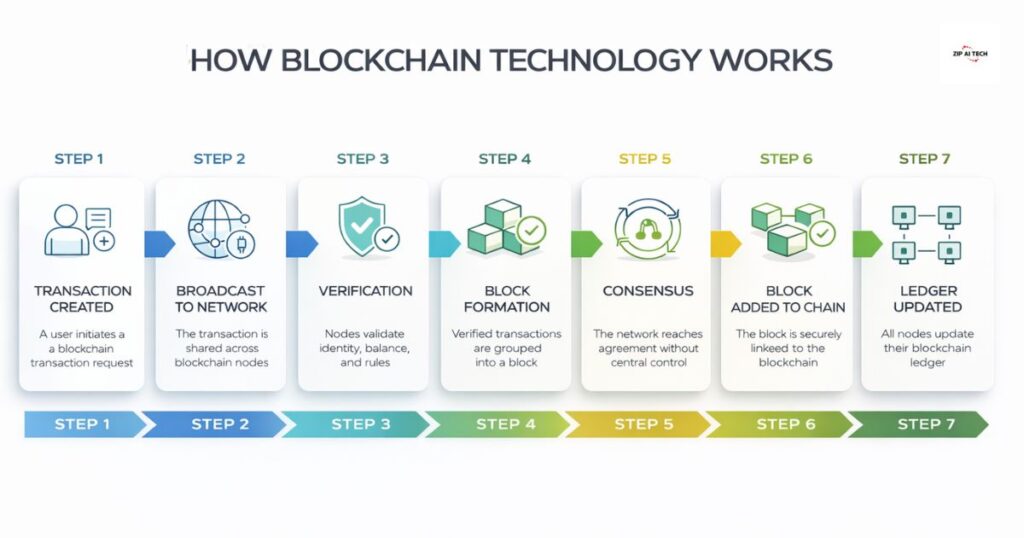
Step 1: A Transaction Is Created
A user requests an action on the blockchain network. This may involve transferring digital assets, updating ownership, or triggering automated logic. At this stage, the transaction exists only as a request.
Step 2: The Transaction Is Shared Across the Network
The request is sent to multiple computers, known as nodes. Each node holds a copy of the blockchain ledger and receives the transaction for review.
Step 3: Verification Takes Place
Nodes check the transaction using network rules. They confirm identity authenticity, validate balances or permissions, and confirm that the data follows protocol conditions.
Step 4: Transactions Are Grouped Into a Block
Verified transactions are collected together. This group forms a block that contains transaction details, timestamps, and cryptographic references to earlier blocks.
Step 5: Network Agreement Is Reached
The blockchain network approves the block through a consensus process. Different networks use different approval methods, but the goal remains the same: shared agreement without central control.
Step 6: The Block Is Added to the Chain
Once approved, the block connects to the previous block using a cryptographic link. This connection secures the data and locks the block into position.
Step 7: The Ledger Updates Everywhere
All nodes update their copy of the ledger. The transaction now becomes a permanent part of the blockchain and remains visible for future verification.
Key Building Blocks of Blockchain Technology
Blocks
Each block contains transaction data, a timestamp, and a cryptographic fingerprint of the previous block.
Nodes
Nodes act as validators and record keepers. They maintain network integrity.
Distributed Ledger
The ledger exists across multiple locations, preventing centralized failure.
Cryptographic Hashes
Hashes lock data into fixed digital fingerprints. Changing data breaks the chain.
Consensus Rules
Consensus methods decide which data becomes valid across the network.
Types of Blockchain Technology
Public Blockchain
Anyone can join and participate. Transparency remains high, and control spreads across the network.
Private Blockchain
Access remains limited to approved participants. Enterprises often choose this model for internal operations.
Consortium Blockchain
Multiple organizations manage the network jointly. Control distributes among known parties.
Hybrid Blockchain
This approach combines open verification with restricted data access.
Each type addresses different operational needs.
Understanding Consensus Without Complexity
Consensus ensures agreement across distributed systems.
Proof of Work
Computers solve cryptographic puzzles to confirm transactions. Security remains strong, though energy use stays high.
Proof of Stake
Validators gain selection rights based on asset ownership rather than computation power.
Alternative Models
New consensus systems continue to emerge, aiming to improve speed and efficiency.
Core Features That Define Blockchain
- Decentralized structure reduces control concentration
- Transparent records allow public verification
- Immutable data preserves history
- Cryptographic security protects integrity
- Traceable activity supports audits and compliance
These features work together rather than in isolation.
Benefits of Blockchain Technology
Operational Advantages
- Reduced fraud risk
- Faster transaction settlement
- Lower dependency on intermediaries
- Improved audit transparency
User-Level Impact
- Greater control over digital assets
- Reduced reliance on centralized platforms
- Improved trust in shared systems
Blockchain shifts ownership from institutions to participants.
Limitations That Still Exist
Blockchain adoption faces practical challenges:
- Network scalability constraints
- Energy consumption in some systems
- Regulatory uncertainty across regions
- Integration complexity
- Privacy trade-offs in public ledgers
These factors shape real-world implementation decisions.
Real-World Applications of Blockchain Technology
Cryptocurrencies
Blockchain enables peer-to-peer digital currency without central banks.
Supply Chain Tracking
Companies trace goods from origin to delivery with verified records.
Healthcare Data
Patient records remain secure and interoperable.
Digital Identity
Users manage identity without centralized databases.
Voting Systems
Blockchain-based voting reduces tampering risk.
Digital Ownership
NFTs verify ownership of digital content.
Blockchain Products and Tools in Use Today
Blockchain Platforms
- Enterprise-grade distributed ledger systems
- Smart contract execution environments
- Decentralized application frameworks
Wallet Solutions
- Hardware wallets for cold storage
- Mobile wallets for daily use
- Software wallets for developers
Developer Infrastructure
- Blockchain explorers
- Node hosting services
- Smart contract testing tools
These products translate blockchain theory into usable systems.
Blockchain Compared With Traditional Systems
| Aspect | Blockchain Ledger | Centralized Database |
|---|---|---|
| Control | Shared network | Single authority |
| Data Changes | Restricted | Editable |
| Security Model | Cryptographic | Access-based |
| Failure Risk | Distributed | Centralized |
Choosing blockchain depends on trust and transparency requirements.
Blockchain and Cryptocurrency: Clearing the Confusion
Blockchain supports cryptocurrency transactions, yet the technology itself serves broader purposes. Many enterprise blockchains operate without digital coins.
Cryptocurrency represents one use case rather than the foundation itself.
Want to understand how intelligent systems think and learn?
Read our clear explanation of artificial intelligence
Security Within Blockchain Networks
Blockchain security relies on:
- Mathematical encryption
- Distributed verification
- Economic incentives
Attacks require enormous resources and coordination, reducing feasibility at scale.
The Direction Blockchain Is Moving Toward
Blockchain development focuses on:
- Scalability improvements
- Energy-efficient consensus
- Integration with AI and IoT
- Enterprise and government adoption
These shifts push blockchain closer to mainstream infrastructure.
Conclusion
Blockchain technology reshapes how digital trust operates. By distributing control and preserving transparent records, it challenges centralized models that dominate online systems. Understanding how blockchain works opens the door to informed decisions, whether for learning, investing, or building future digital products. Follow us for daily tech insights and updates: Facebook | Instagram | Pinterest.
FAQs
Q.1 What is blockchain technology in simple words?
A shared digital record system where data remains difficult to alter.
Q.2 Is blockchain safe?
Security comes from cryptography and decentralized validation.
Q.3 Can blockchain data change?
Once recorded, data remains fixed unless the entire network agrees.
Q.4 Does blockchain need the internet?
Most blockchain networks rely on connectivity to function.



One thought on “What Is Blockchain Technology and How It Works”